

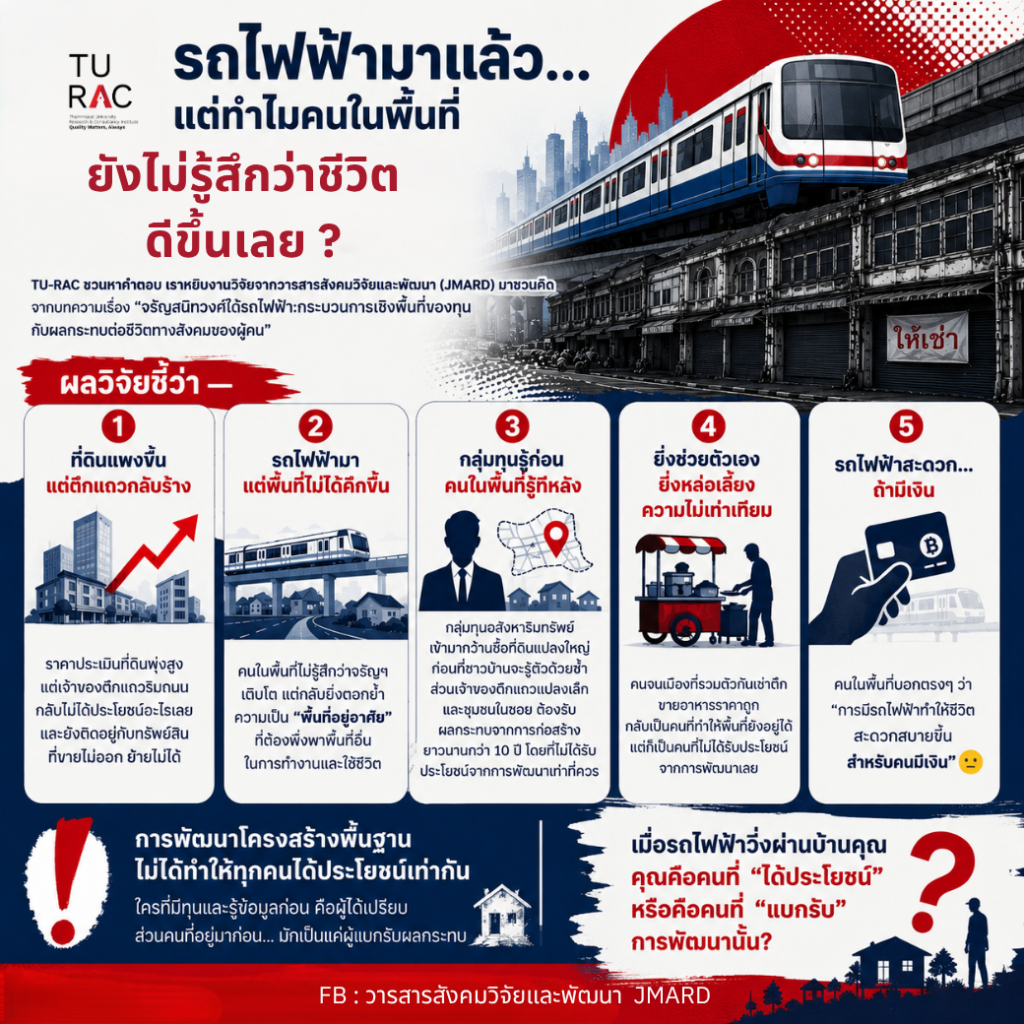
🚉 The skytrain has arrived…
But why do people in the neighborhood still feel like life hasn’t improved?
Everyone says mass transit brings development.
Land prices soar, condominiums spring up everywhere.
But for long-time residents of Charan Sanitwong, the feeling is quite the opposite.
.
TU-RAC invites you to rethink urban development through research published in the Journal of Multidisciplinary Academic Research and Development (JMARD).
Based on the article:
“Charan Sanitwong under the MRT Blue Line: The SpatialProcess of Capital and Its Impact on Social Life”
Published in JMARD by the Thammasat University Research and Consultancy Institute Author: Chantanee Charoensri
Faculty of Sociology and Anthropology, Thammasat University
.
✨ The research findings reveal that —
Fieldwork conducted in Charan Sanitwong found that…
1️⃣ Land prices increased, but shophouses were left vacant
Land appraisal values skyrocketed, yet owners of roadside shophouses gained little benefit. Many became trapped with properties they could neither sell nor leave behind.
2️⃣ The skytrain arrived, but the area did not become more vibrant
Residents do not feel that Charanฯ has truly grown. Instead, it has become even more defined as a “residential area” dependent on other districts for work and everyday life.
3️⃣ Developers knew first. Residents found out later.
Real estate investors had already acquired large plots of land before local residents even realized what was happening. Meanwhile, small shophouse owners and communities in the alleys endured over a decade of construction impacts without receiving proportional benefits from the development.
4️⃣ The more people helped themselves, the more inequality was sustained
Urban poor communities who grouped together to rent buildings and sell affordable food became the very people keeping the area alive — yet they remained excluded from the benefits of development.
5️⃣ The skytrain is convenient… if you can afford it
Residents said it plainly:
“Having the skytrain makes life more convenient — for people with money.” 😶
.
🔍 Infrastructure development does not benefit everyone equally.
Those with capital and early access to information gain the advantage.
Those who were there first often end up carrying the burden of development instead. 🏚️
.
💬 When the skytrain runs past your home,
are you the one who benefits —
or the one who bears the cost of that development? 🤔
.
📖 Read the full research article here:
https://he02.tci-thaijo.org/index.php/JMARD/article/view/278023/190213
