

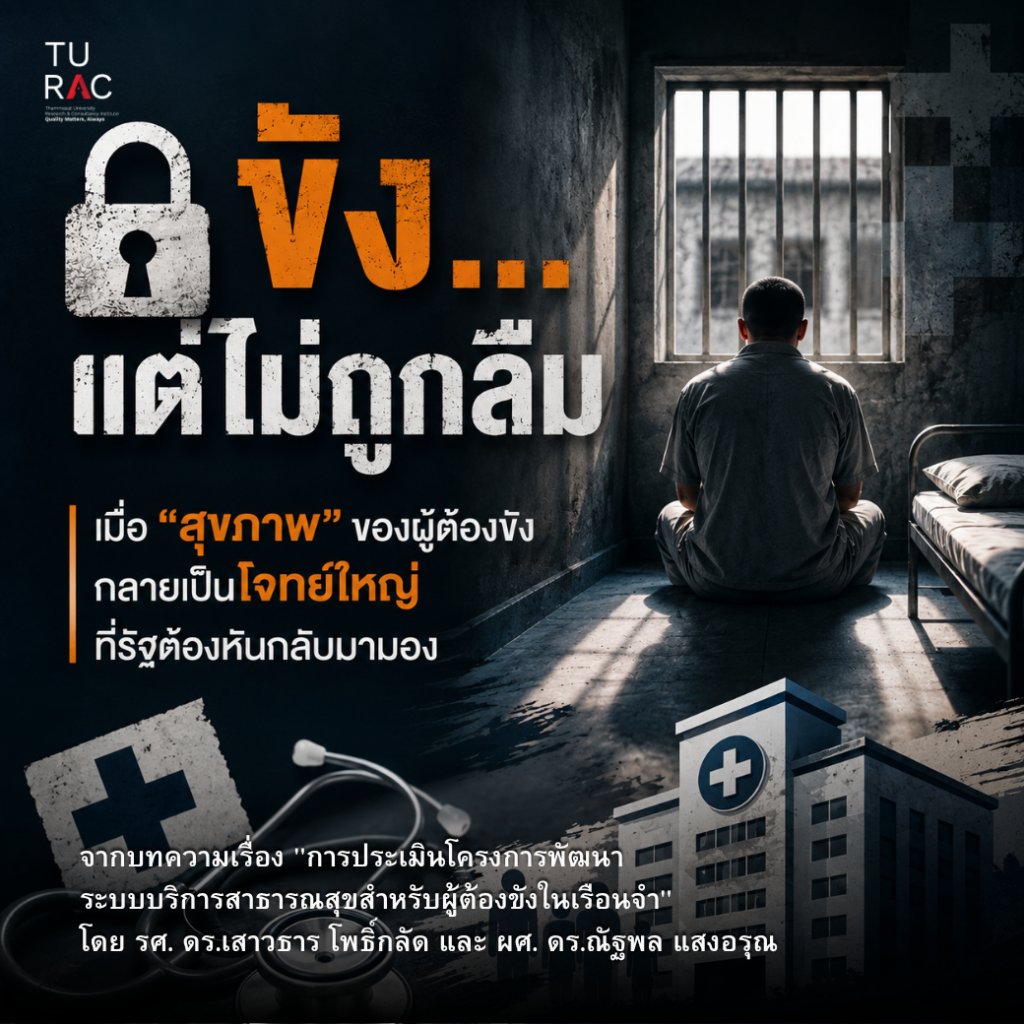
TU-RAC invites you to explore a research article published in the Journal of Multidisciplinary Academic Research and Development (JMARD) entitled “Evaluation of the project to develop a public health service system for prisoners in prisons”, published in JMARD, Vol. 7, No. 3 (2025) by Assoc. Prof. Dr. Saowathan Phoglad, Faculty of Social Administration, Thammasat University, and Asst. Prof. Dr. Nattapon Sang-arun, College of Interdisciplinary Studies, Thammasat University.
✨ Key Findings
🔹 A nationwide evaluation of prison healthcare services
The study evaluated the “ Health rights and welfare, The Good Health, Good Heart Project” initiative across 30 prisons and correctional institutions nationwide. Data were collected from 666 participants through quantitative methods and 180 participants through qualitative interviews, including administrators, prison staff, inmates, and prison health volunteers.
🔹 High levels of satisfaction
Both inmates and prison personnel reported high overall satisfaction with the program. Average satisfaction scores were 4.25 and 4.22 out of 5, respectively, while the project’s success was rated at 4.05 and 4.09.
🔹 Cost-effective from a public health perspective
Using Cost-Effectiveness Analysis (CEA), the study found that the project required an investment of over 335 million baht and achieved 34 performance indicators, contributing to improved living standards for 108,146 inmates.
🔹 Leadership matters
The findings indicate that prisons where senior administrators actively prioritized healthcare implementation achieved smoother policy execution. This suggests that the program’s success still depends heavily on leadership rather than on institutionalized, sustainable systems.
⚠️ Challenges That Remain
- Healthcare funding remains focused primarily on medical services, while budgets for facility improvements and sanitation are still insufficient.
- Some inmate groups, including foreign nationals and individuals without Thai national identification numbers, still face barriers to accessing Thailand’s Universal Health Coverage.
- The adoption of digital health technologies is constrained by prison data security requirements.
- Continuity of healthcare after release remains weak, with limited integration into local public health systems.
🔍 The study concludes that the program has contributed to reducing illness and mortality among inmates. However, achieving long-term sustainability will require moving from leadership-dependent success toward standardized systems and institutional mechanisms that remain effective regardless of changes in personnel.
💬 If health is a fundamental human right, even for those behind prison walls, how can we design a system where no one is left behind? 🤔
📖 Read the full article:
https://he02.tci-thaijo.org/index.php/JMARD/article/view/275065/188420
