

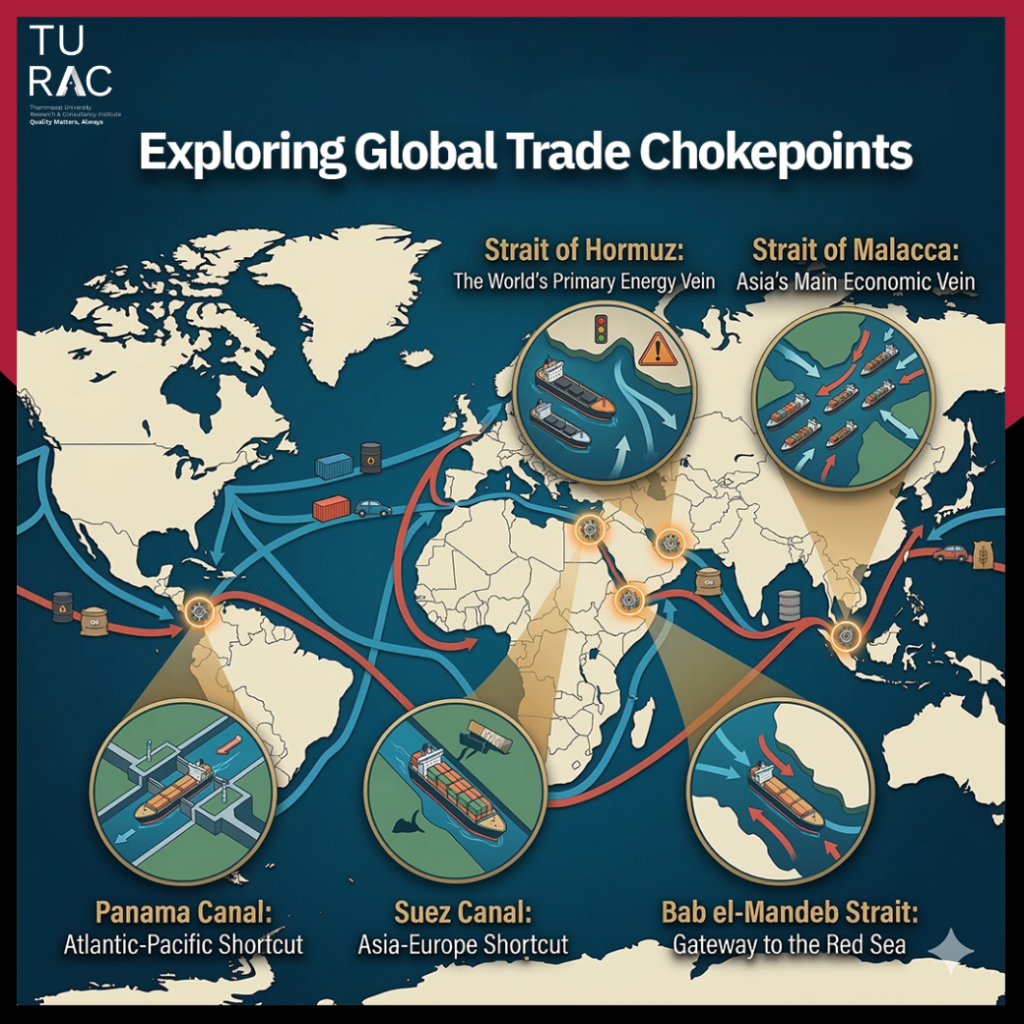
In today’s global economic system, more than 80–90% of the world’s traded goods by volume are transported by sea through a network of shipping routes connecting different continents. Yet within this seemingly vast network, there are only a few “maritime chokepoints” that are critically important. If any one of these points were to face conflict or become blocked, it could immediately affect the global economy. A well-known example familiar to people around the world is the Strait of Hormuz, a narrow passage between Iran and Oman that serves as the main outlet for oil from the Middle East to global markets. Around 20.9 million barrels of oil pass through it each day, accounting for approximately 20% of global oil consumption. It is therefore not an exaggeration to call this location the “main artery of the world’s energy supply,” which is currently heating up amid the flames of conflict. However, the Strait of Hormuz is not the only chokepoint with such a level of importance. The world also has several other strategic trade locations with similar characteristics.
.
- The Strait of Malacca is considered the main artery of the Asian economy. This strait connects the Indian Ocean with the South China Sea and serves as the most important shortcut between the Middle East and East Asia. Massive volumes of oil used in China, Japan, South Korea, and ASEAN countries must pass through this point. The risks associated with the Strait of Malacca include its narrow navigation route and extremely dense shipping traffic, which increases the risk of accidents or attacks. If the strait were closed, ships would have to detour around Indonesia, adding thousands of kilometers to their journeys.
- The Suez Canal serves as a shortcut between Asia and Europe. The canal is a major shipping route that cuts across Egypt, connecting the Mediterranean Sea with the Red Sea. An event that clearly demonstrated the vulnerability of this location was the Suez Canal blockage by Ever Given. A single container ship became stuck and blocked the canal, causing global trade losses worth billions of dollars per day.
- The Bab el-Mandeb Strait acts as the gateway to the Red Sea. This strait lies between Yemen and Africa and connects the Red Sea with the Indian Ocean. It is a key route for goods heading toward the Suez Canal. If this chokepoint were closed, ships traveling from Asia would have to sail around the Cape of Good Hope, increasing the distance by approximately 6,000–10,000 kilometers.
- The Panama Canal serves as a shortcut between the Atlantic and Pacific Oceans. The Panama Canal is a crucial piece of infrastructure for the Western Hemisphere and is a major route for trade between the United States, Latin America, and Asia. If this canal were unavailable, ships would need to sail around South America, which would increase travel time by 10–15 days.
.
Although the world’s oceans are vast, a significant portion of global trade must pass through only a few narrow gateways, such as the Strait of Hormuz, the Strait of Malacca, the Suez Canal, the Bab el-Mandeb Strait, and the Panama Canal. These locations function like the “valves of the global economic system.” When the valves are open, goods, energy, and resources flow smoothly. But when any one of these valves is closed, the impact is not limited to that region alone; it can send shockwaves throughout the entire global economy.
